Participation in Mediated Communication Can Fulfill All of the Following Functions Except
6.ane Principles of Interpersonal Communication
Learning Objectives
- Define interpersonal communication.
- Discuss the functional aspects of interpersonal communication.
- Discuss the cultural aspects of interpersonal communication.
In order to understand interpersonal communication, nosotros must empathize how interpersonal communication functions to run into our needs and goals and how our interpersonal communication connects to larger social and cultural systems. Interpersonal communication is the process of exchanging messages between people whose lives mutually influence one another in unique ways in relation to social and cultural norms. This definition highlights the fact that interpersonal advice involves two or more people who are interdependent to some degree and who build a unique bail based on the larger social and cultural contexts to which they belong. So a brief commutation with a grocery store clerk who you don't know wouldn't exist considered interpersonal communication, because you and the clerk are not influencing each other in meaning ways. Apparently, if the clerk were a friend, family member, coworker, or romantic partner, the communication would autumn into the interpersonal category. In this department, nosotros discuss the importance of studying interpersonal communication and explore its functional and cultural aspects.
Why Study Interpersonal Communication?
Interpersonal communication has many implications for us in the real world. Did you lot know that interpersonal communication played an important role in human evolution? Early on humans who lived in groups, rather than lone, were more likely to survive, which meant that those with the capability to develop interpersonal bonds were more probable to pass these traits on to the next generation (Leary, 2001). Did you lot know that interpersonal skills accept a measurable impact on psychological and physical health? People with higher levels of interpersonal advice skills are meliorate able to conform to stress, have greater satisfaction in relationships and more friends, and have less depression and anxiety (Hargie, 2011). In fact, prolonged isolation has been shown to severely damage a human (Williams & Zadro, 2001). Have you ever heard of the boy or daughter who was raised by wolves? At that place have been documented cases of abandoned or neglected children, sometimes referred to as feral children, who survived using their animalistic instincts but suffered psychological and physical trauma every bit a result of their isolation (Candland, 1995). There are also examples of lone confinement, which has become an upstanding issue in many countries. In "supermax" prisons, which now operate in at to the lowest degree forty-iv states, prisoners spend 22.5 to 24 hours a mean solar day in their cells and have no contact with the exterior earth or other prisoners (Shalev, 2011).

Alone confinement is common in supermax prisons, where prisoners spend 22.5 to 24 hours a mean solar day in their cells.
Bated from making your relationships and health better, interpersonal communication skills are highly sought after by potential employers, consistently ranking in the top ten in national surveys (National Association of Colleges and Employers, 2010). Each of these examples illustrates how interpersonal communication meets our basic needs equally humans for security in our social bonds, health, and careers. But we are not born with all the interpersonal communication skills we'll demand in life. And then in order to brand the almost out of our interpersonal relationships, we must learn some basic principles.
Recollect about a time when a short communication substitution affected a relationship almost immediately. Did you lot mean for it to happen? Many times we engage in interpersonal communication to fulfill sure goals nosotros may take, but sometimes we are more successful than others. This is because interpersonal communication is strategic, meaning nosotros intentionally create messages to attain certain goals that help u.s.a. function in order and our relationships. Goals vary based on the state of affairs and the communicators, but inquire yourself if you lot are generally successful at achieving the goals with which y'all enter a conversation or non. If then, you may already possess a high caste of interpersonal communication competence, or the ability to communicate effectively and appropriately in personal relationships. This chapter will help you understand some key processes that tin can make us more than effective and appropriate communicators. You may be asking, "Aren't effectiveness and appropriateness the same affair?" The answer is no. Imagine that you lot are the manager of a small-scale section of employees at a marketing agency where you often have to work on deadlines. Every bit a borderline approaches, you worry about your team's ability to work without your supervision to complete the tasks, so you lot interrupt everyone's piece of work and assign them all individual tasks and give them a bulleted list of each subtask with a deadline to plow each office in to you. You meet the borderline and have effectively accomplished your goal. Over the next month, one of your employees puts in her two-weeks' notice, and you learn that she and a few others have been talking about how they struggle to work with y'all as a manager. Although your strategy was effective, many people practise not answer well to strict hierarchy or micromanaging and may accept deemed your communication inappropriate. A more than competent communicator could have implemented the same detailed program to achieve the chore in a mode that included feedback, making the employees experience more included and heard. In order to be competent interpersonal communicators, we must learn to residuum beingness effective and appropriate.
Functional Aspects of Interpersonal Advice
We take dissimilar needs that are met through our various relationships. Whether we are enlightened of it or not, we oftentimes ask ourselves, "What can this relationship do for me?" In order to empathise how relationships accomplish strategic functions, we will look at instrumental goals, relationship-maintenance goals, and self-presentation goals.
What motivates you lot to communicate with someone? Nosotros ofttimes engage in communication designed to achieve instrumental goals such as gaining compliance (getting someone to do something for usa), getting information we need, or asking for support (Burleson, Metts, & Kirch, 2000). In short, instrumental talk helps us "get things washed" in our relationships. Our instrumental goals tin can be long term or twenty-four hours to day. The following are examples of communicating for instrumental goals:
- You ask your friend to help you move this weekend (gaining/resisting compliance).
- You lot enquire your coworker to remind you lot how to balance your cash register till at the end of your shift (requesting or presenting information).
- You console your roommate after he loses his job (asking for or giving support).
When we communicate to accomplish relational goals, we are striving to maintain a positive human relationship. Engaging in relationship-maintenance advice is like taking your car to be serviced at the repair shop. To have a practiced human relationship, just as to have a long-lasting car, we should engage in routine maintenance. For example, have you ever wanted to stay in and club a pizza and watch a movie, but your friend suggests that you lot go to a local restaurant and then to the theatre? Mayhap you don't feel like being around a lot of people or spending money (or changing out of your pajamas), but you decide to go along with his or her suggestion. In that moment, you are putting your relational partner's needs above your own, which will likely make him or her feel valued. Information technology is likely that your friend has fabricated or will as well make similar concessions to put your needs kickoff, which indicates that in that location is a satisfactory and complimentary relationship. Plain, if one partner always insists on having his or her way or always concedes, becoming the martyr, the individuals are not exhibiting interpersonal-communication competence. Other routine relational tasks include jubilant special occasions or honoring accomplishments, spending time together, and checking in regularly by phone, e-post, text, social media, or face up-to-face advice. The post-obit are examples of communicating for relational goals:
- Yous organize an office party for a coworker who has just go a US citizen (celebrating/honoring accomplishments).
- You lot brand breakfast with your mom while you are abode visiting (spending time together).
- You mail service a bulletin on your long-altitude friend'southward Facebook wall saying y'all miss him (checking in).
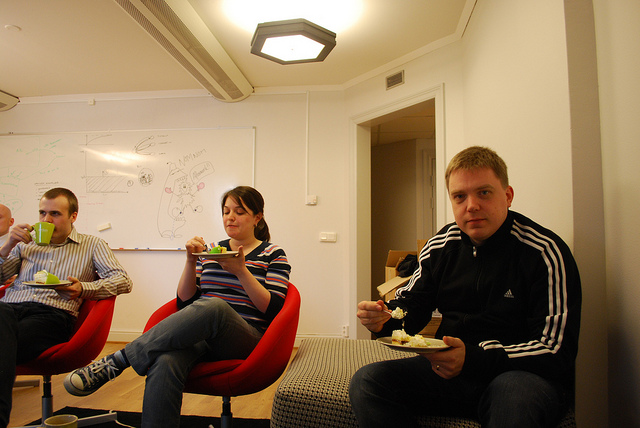
Gathering to celebrate a colleague'due south birthday is a skillful way for coworkers to achieve relational goals in the workplace.
Another grade of relational talk that I have establish very useful is what I call the DTR talk, which stands for "defining-the-relationship talk" and serves a relationship-maintenance function. In the early on stages of a romantic relationship, y'all may accept a DTR talk to reduce incertitude most where yous stand up by deciding to use the term fellow, girlfriend, or partner. In a DTR talk, you may proactively define your relationship past saying, "I'thou glad I'm with y'all and no one else." Your romantic interest may respond favorably, echoing or rephrasing your statement, which gives y'all an indication that he or she agrees with you. The talk may continue on from there, and you may talk nearly what to phone call your relationship, set boundaries, or non. Information technology is not unusual to have several DTR talks as a human relationship progresses. At times, yous may take to ascertain the relationship when someone steps over a line past maxim, "I think nosotros should but exist friends." This more explicit and reactive (rather than proactive) communication can be especially useful in situations where a relationship may be unethical, inappropriate, or create a disharmonize of interest—for example, in a supervisor-supervisee, mentor-mentee, professional-customer, or collegial relationship.
Nosotros also pursue self-presentation goals by adapting our communication in order to be perceived in particular ways. Merely equally many companies, celebrities, and politicians create a public paradigm, nosotros desire to present dissimilar faces in different contexts. The well-known scholar Erving Goffman compared self-presentation to a performance and suggested we all perform different roles in different contexts (Goffman, 1959). Indeed, competent communicators can successfully manage how others perceive them by adapting to situations and contexts. A parent may perform the role of stern head of household, supportive shoulder to cry on, or hip and culturally aware friend to his or her kid. A newly hired employee may initially perform the office of serious and agreeable coworker. Sometimes people engage in communication that doesn't necessarily present them in a positive way. For example, Haley, the oldest daughter in the television show Modern Family, often presents herself as incapable in order to become her parents to practice her work. In one episode she pretended she didn't know how to crevice open an egg and so her mom Claire would make the brownies for her school bake sale. Here are another examples of communicating to meet self-presentation goals:
- As your boss complains about struggling to format the company newsletter, you tell her about your feel with Microsoft Word and editing and offer to look over the newsletter once she'south done to prepare the formatting (presenting yourself as competent).
- You and your new college roommate stand up in your dorm room full of boxes. You let him cull which side of the room he wants and then invite him to eat lunch with you (presenting yourself as friendly).
- You say, "I don't know," in response to a professor's question even though you accept an idea of the answer (presenting yourself as aloof, or "too cool for schoolhouse").
"Getting Real"
Image Consultants
The Association of Image Consultants International (AICI) states that appearance, behavior, and communication are the "ABC's of image." Many professional image consultants are licensed by this organization and provide a variety of services to politicians, actors, corporate trainers, public speakers, organizations, corporations, and television personalities such equally news anchors.[1] Visit the AICI's website (http://world wide web.aici.org/About_Image_Consulting/Image_Consulting.htm) and read nearly epitome consulting, including the "How to Cull," "How to Go," and "FAQs" sections. Then consider the following questions:
- If you were to hire an paradigm consultant for yourself, what would you have them "piece of work on" for you? Why?
- What communication skills that you've learned about in the volume and so far would be almost important for an paradigm consultant to possess?
- Many politicians use image consultants to assist them connect to voters and win elections. Do you remember this is upstanding? Why or why not?
As if managing instrumental, relational, and self-presentation goals isn't difficult enough when we consider them individually, we must too realize that the three goal types are always working together. In some situations nosotros may privilege instrumental goals over relational or self-presentation goals. For example, if your partner is offered a peachy job in another land and you decided to go with him or her, which will move you away from your job and social circle, y'all would be focusing on relational goals over instrumental or self-presentation goals. When you're facing a stressful state of affairs and demand your best friend's help and call saying, "Hurry and bring me a gallon of gas or I'm going to be late to piece of work!" you are privileging instrumental goals over relational goals. Of grade, if the person really is your best friend, you can try to smooth things over or brand up for your shortness after. Withal, you probably wouldn't phone call your boss and bark a request to bring you a gallon of gas so you lot tin can get to work, considering yous likely want your dominate to see you equally dependable and likable, meaning you have focused on self-presentation goals.
The functional perspective of interpersonal advice indicates that we communicate to reach certain goals in our relationships. We become things done in our relationships by communicating for instrumental goals. We maintain positive relationships through relational goals. We also strategically present ourselves in order to be perceived in particular ways. Equally our goals are met and our relationships build, they get lilliputian worlds we inhabit with our relational partners, complete with their own human relationship cultures.
Cultural Aspects of Interpersonal Communication
Aside from functional aspects of interpersonal advice, communicating in relationships as well helps establish human relationship cultures. Only equally large groups of people create cultures through shared symbols (language), values, and rituals, people in relationships too create cultures at a smaller level. Relationship cultures are the climates established through interpersonal communication that are unique to the relational partners only based on larger cultural and social norms. We as well enter into new relationships with expectations based on the schemata nosotros have developed in previous relationships and learned from our larger society and culture. Recall of relationship schemata every bit blueprints or plans that show the inner workings of a relationship. Just like a schematic or diagram for assembling a new computer desk helps you put it together, relationship schemata guide us in how we believe our interpersonal relationships should piece of work and how to create them. And then from our life experiences in our larger cultures, we bring building blocks, or expectations, into our relationships, which fundamentally connect our relationships to the outside world (Burleson, Metts, & Kirch, 2000). Fifty-fifty though we experience our relationships as unique, they are at least partially built on preexisting cultural norms.
Some boosted communicative acts that create our relational cultures include relational storytelling, personal idioms, routines and rituals, and rules and norms. Storytelling is an of import part of how we create culture in larger contexts and how we create a uniting and meaningful storyline for our relationships. In fact, an anthropologist coined the term human narrans to describe the unique storytelling capability of modernistic humans (Fisher, 1985). We often rely on relationship storytelling to create a sense of stability in the confront of change, test the compatibility of potential new relational partners, or create or maintain solidarity in established relationships. Think of how you use storytelling amidst your friends, family, coworkers, and other relational partners. If you recently moved to a new place for higher, you probably experienced some big changes. One of the first things y'all started to do was reestablish a social network—remember, human beings are fundamentally social creatures. Equally you began to see new people in your classes, at your new job, or in your new housing, you virtually likely told some stories of your life before—nigh your friends, task, or teachers back home. 1 of the functions of this type of storytelling, early in forming interpersonal bonds, is a test to run into if the people you are meeting have similar stories or tin can chronicle to your previous human relationship cultures. In short, y'all are testing the compatibility of your schemata with the new people you meet. Although storytelling will go on to play a office in your relational evolution with these new people, you may be surprised at how quickly you start telling stories with your new friends about things that have happened since you lot met. You may recount stories about your beginning trip to the trip the light fantastic order together, the weird geology professor you had together, or the time yous all got sick from eating the cafeteria food. In short, your onetime stories will commencement to give way to new stories that you've created. Storytelling within relationships helps create solidarity, or a sense of belonging and closeness. This type of storytelling can exist particularly meaningful for relationships that don't autumn into the dominant culture. For case, research on a gay male friendship circle plant that the gay men retold certain dramatic stories frequently to create a sense of belonging and to also bring in new members to the grouping (Jones Jr., 2007).
We also create personal idioms in our relationships (Bell & Healey, 1992). If you've ever studied foreign languages, you know that idiomatic expressions similar "I'thou under the conditions today" are basically nonsense when translated. For example, the equivalent of this expression in French translates to "I'm non in my plate today." When you think near it, it doesn't make sense to use either expression to communicate that you're sick, but the pregnant would non be lost on English or French speakers, because they can decode their respective idiom. This is too truthful of idioms we create in our interpersonal relationships. But as idioms are unique to individual cultures and languages, personal idioms are unique to sure relationships, and they create a sense of belonging due to the inside meaning shared by the relational partners. In romantic relationships, for example, it is common for individuals to create nicknames for each other that may not directly translate for someone who overhears them. Yous and your partner may detect that calling each other "booger" is sweet, while others may think it's gross. Researchers have found that personal idioms are commonly used in the following categories: activities, labels for others, requests, and sexual references (Bong & Healey, 1992). The recent cultural phenomenon Jersey Shore on MTV has given us plenty of examples of personal idioms created by the friends on the show. GTL is an activity idiom that stands for "gym, tan, laundry"—a common routine for the cast of the show. There are many examples of idioms labeling others, including grenade for an unattractive female, gorilla juice head for a very muscular man, and backpack for a clingy boyfriend/girlfriend or a clingy person at a guild. There are also many idioms for sexual references, such every bit smush, meaning to hook up / have sex, and smush room, which is the room set aside for these activities (Benigno, 2010). Idioms assist create cohesiveness, or solidarity in relationships, because they are shared cues between cultural insiders. They also communicate the uniqueness of the relationship and create boundaries, since meaning is only shared within the relationship.
Routines and rituals aid form relational cultures through their natural development in repeated or habitual interaction (Burleson, Metts, & Kirch, 2000). While "routine" may connote deadening in some situations, relationship routines are chatty acts that create a sense of predictability in a relationship that is comforting. Some communicative routines may develop around occasions or conversational topics.
For example, information technology is common for long-altitude friends or relatives to schedule a recurring telephone conversation or for couples to review the day's events over dinner. When I studied abroad in Sweden, my parents and I talked on the telephone at the same time every Sun, which established a comfortable routine for us. Other routines develop around entire conversational episodes. For case, ii all-time friends recounting their favorite spring-break story may seamlessly switch from one speaker to the other, end each other's sentences, speak in unison, or gesture simultaneously because they have told the story so many times. Relationship rituals accept on more symbolic meaning than do relationship routines and may exist variations on widely recognized events—such every bit birthdays, anniversaries, Passover, Christmas, or Thanksgiving—or highly individualized and original. Relational partners may personalize their traditions by eating mussels and playing Yahtzee on Christmas Eve or going hiking on their anniversary. Other rituals may be more unique to the relationship, such every bit celebrating a dog's altogether or going to opening day at the amusement park. The following highly idiosyncratic ritual was reported by a participant in a inquiry study:
I would check my hubby's umbilicus for fuzz on a daily basis at bedtime. It originated when I noticed some coating fuzz in his umbilicus one day and thought information technology was funny…We both found it funny and teased frequently most the fuzz. If there wasn't whatever fuzz for a few days my married man would put some in his bellybutton for me to find. It'due south been happening for nigh 10 years now (Bruess & Pearson, 1997).

A couple may share a human relationship routine of making dinner together every Saturday night.
Free Stock Photos – Cooking – public domain.
Whether the routines and rituals involve telephone calls, eating certain foods, or digging for belly button fuzz, they all serve important roles in building relational cultures. However, every bit with storytelling, rituals and routines can exist negative. For instance, verbal and nonverbal patterns to berate or scoff your relational partner will non have salubrious effects on a relational civilisation. Additionally, visiting your in-laws during the holidays loses its symbolic value when you dislike them and comply with the ritual because you feel like yous have to. In this instance, the ritual doesn't enrich the relational culture, merely information technology may reinforce norms or rules that accept been created in the human relationship.
Relationship rules and norms assistance with the daily function of the human relationship. They help create structure and provide boundaries for interacting in the relationship and for interacting with larger social networks (Burleson, Metts, & Kirch, 2000). Relationship rules are explicitly communicated guidelines for what should and should not exist washed in certain contexts. A couple could create a rule to ever confer with each other before letting their kid spend the night somewhere else. If a mother lets her son sleep over at a friend's house without consulting her partner, a more serious disharmonize could result. Human relationship norms are similar to routines and rituals in that they develop naturally in a human relationship and generally conform to or are adapted from what is expected and adequate in the larger culture or social club. For instance, it may exist a norm that y'all and your coworkers practise not "talk shop" at your Friday happy-hour gathering. And then when someone brings up piece of work at the gathering, his coworkers may remind him that there'south no shop talk, and the consequences may not be that serious. In regards to topic of conversation, norms often guide expectations of what subjects are appropriate within various relationships. Practise you talk to your boss nearly your personal finances? Do you talk to your father about your sex activity? Do yous tell your classmates virtually your medical history? In general, there are no rules that say you lot can't discuss any of these topics with anyone you choose, merely relational norms usually lead people to answer "no" to the questions in a higher place. Violating relationship norms and rules tin negatively affect a relationship, but in full general, rule violations tin can lead to more direct conflict, while norm violations can lead to bad-mannered social interactions. Developing your interpersonal communication competence will help you appraise your communication in relation to the many rules and norms you will encounter.
Central Takeaways
- Getting integrated: Interpersonal communication occurs between ii or more people whose lives are interdependent and mutually influence one some other. These relationships occur in academic, professional, personal, and civic contexts, and improving our interpersonal communication competence can besides amend our physical and psychological health, enhance our relationships, and make the states more successful in our careers.
-
There are functional aspects of interpersonal communication.
- We "go things done" in our relationships by communicating for instrumental goals such equally getting someone to do something for us, requesting or presenting information, and asking for or giving support.
- We maintain our relationships past communicating for relational goals such equally putting your relational partner's needs earlier your own, jubilant accomplishments, spending fourth dimension together, and checking in.
- Nosotros strategically project ourselves to be perceived in item means by communicating for self-presentation goals such as appearing competent or friendly.
-
There are cultural aspects of interpersonal communication.
- We create relationship cultures based on the relationship schemata we develop through our interactions with our larger order and culture.
- We engage in relationship storytelling to create a sense of stability in the face of change, to test our compatibility with potential relational partners, and to create a sense of solidarity and belonging in established relationships.
- Nosotros create personal idioms such as nicknames that are unique to our item relationship and are unfamiliar to outsiders to create cohesiveness and solidarity.
- We establish relationship routines and rituals to assistance institute our relational culture and bring a sense of comfort and predictability to our relationships.
Exercises
- Getting integrated: In what means might interpersonal communication competence vary among bookish, professional, and borough contexts? What competence skills might be more or less important in ane context than in another?
- Recount a time when y'all had a DTR talk. At what stage in the relationship was the talk? What motivated you or the other person to initiate the talk? What was the effect of the talk?
- Choice an of import relationship and describe its relationship civilisation. When the relationship started, what relationship schemata guided your expectations? Describe a relationship story that you tell with this person or about this person. What personal idioms practise you apply? What routines and rituals practise you lot detect? What norms and rules do you follow?
References
Bell, R. A. and J. G. Healey, "Idiomatic Communication and Interpersonal Solidarity in Friends' Relational Cultures," Man Communication Research 18 (1992): 307–35.
Benigno, A., "Jersey Shore Glossary: This Dictionary of Terms Will Get You (Fist) Pumped for Season Two," N.Y. Daily News, July 28, 2010, http://articles.nydailynews.com/2010-07-28/entertainment/27071281_1_jersey-shore-fist-pump-snooki.
Bruess, C. J. S. and Judy C. Pearson, "Interpersonal Rituals in Marriage and Adult Friendship," Communication Monographs 64, no. i (1997): 35.
Burleson, B. R., Sandra Metts, and Michael Westward. Kirch, "Communication in Close Relationships," in Close Relationships: A Sourcebook, eds. Clyde Hendrick and Susan S. Hendrick (Thousand Oaks, CA: Sage, 2000), 247.
Candland, D. Chiliad., Feral Children and Clever Animals: Reflections on Human Nature (New York: Oxford University Press, 1995).
Fisher, W. R., "Narration as Human Communication Image: The Case of Public Moral Argument," Communication Monographs 51, no. 1 (1985): 1–22.
Goffman, E., The Presentation of Self in Everyday Life (New York: Anchor Books, 1959).
Hargie, O., Skilled Interpersonal Interaction: Enquiry, Theory, and Exercise (London: Routledge, 2011), ii.
Jones Jr., R. Yard., "Elevate Queens, Drama Queens, and Friends: Drama and Operation as a Solidarity Building Part in a Gay Male person Friendship Circle," Kaleidoscope: A Graduate Journal of Qualitative Communication Enquiry 6, no. 1 (2007): 61–84.
Leary, M. R., "Toward a Conceptualization of Interpersonal Rejection," in Interpersonal Rejection, ed. Marking R. Leary (New York: Oxford University Press, 2001), 3–20.
National Clan of Colleges and Employers, Job Outlook 2011 (2010): 25.
Shalev, S., "Solitary Solitude and Supermax Prisons: A Man Rights and Upstanding Analysis," Journal of Forensic Psychology Practice 11, no. ii (2011): 151.
Williams, G. D. and Lisa Zadro, "Ostracism: On Being Ignored, Excluded, and Rejected," in Interpersonal Rejection, ed. Mark R. Leary (New York: Oxford Academy Press, 2001), 21–54.
winklerexclaugher.blogspot.com
Source: https://open.lib.umn.edu/communication/chapter/6-1-principles-of-interpersonal-communication/
0 Response to "Participation in Mediated Communication Can Fulfill All of the Following Functions Except"
Post a Comment